RDSE: Real-Time Directional Speech Enhancement Framework for Dual-Mic Commodity Smartphones

Accepted at IECON 2026

1National Institute of Technology Jalandhar, India 2Kalinga Institute of Industrial Technology, Bhubaneswar, India 3IMC University of Applied Sciences Krems, Austria

Real-Time Deployment & Live Demo

Real-world validation demonstrating robust directional speech enhancement in uncontrolled environments.

Live Stream Audio (English)

RDSE Enhanced Output

Real-World Mobile Recording (Marathi)

Additional testing using noisy real-world recordings (no video).

Noisy Input Mixture

RDSE Enhanced Output

Controlled Evaluation (SpARZ100 Dataset)

We introduce SpARZ100, a controlled dataset isolating anechoic and reverberant conditions for systematic benchmarking.

Scenario: Anechoic Condition (RT60 = 0.0s)

Target Speech
Mixture (Mic 1)
RDSE Output

Scenario: Reverberant Condition (RT60 = 0.5s)

Target Speech
Mixture (Mic 1)
RDSE Output

Quantitative Results

Method STOI ViSQOL PESQ Time (s) Real-Time Mic Setup Dataset
Anechoic (RT60 = 0.0 s)
RDSE (Dereverb-off) 0.7754 2.0053 2.5755 3.95 ✓ 2-mic SpARZ100
RDSE (Dereverb-on) 0.7356 2.0482 0.8789 10.11 ✓ 2-mic SpARZ100
SepFormer [30] 0.5015 1.5779 1.6239 22.79 × 1-mic SpARZ100
FasNet-TAC [31] 0.4494 1.5670 1.0780 3.50 × 2-mic SpARZ100
Nair et al. (2019) [1] 0.7100 — 2.0400 — × 6-mic AVSpeech
Li et al. (2025) [23] 0.8400 — 2.0300 — × 2-mic VoxCeleb2
Ephrat et al. (2018) [4] — — 2.4200 — × 1-mic TCD-TIMIT
Reverberant (RT60 = 0.5 s)
RDSE (Dereverb-off) 0.5539 1.8710 1.8185 3.69 ✓ 2-mic SpARZ100
RDSE (Dereverb-on) 0.5391 1.9160 0.8527 6.21 ✓ 2-mic SpARZ100
SepFormer [30] 0.4761 1.8253 1.2387 25.35 × 1-mic SpARZ100
FasNet-TAC [31] 0.4332 1.5856 1.0820 3.31 × 2-mic SpARZ100
Nair et al. (2019) [1] 0.5900 — 2.0000 — × 6-mic AVSpeech
Li et al. (2025) [23] 0.6000 — 1.5400 — × 2-mic VoxCeleb2

Table 1: Comparative evaluation against prior work on the SpARZ100 dataset. Inference time is mean seconds per 5-second sample.

RDSE Overlay-guided Mode

Figure 1: The overlay-guided interaction mode of RDSE for real-time target selection.

Abstract

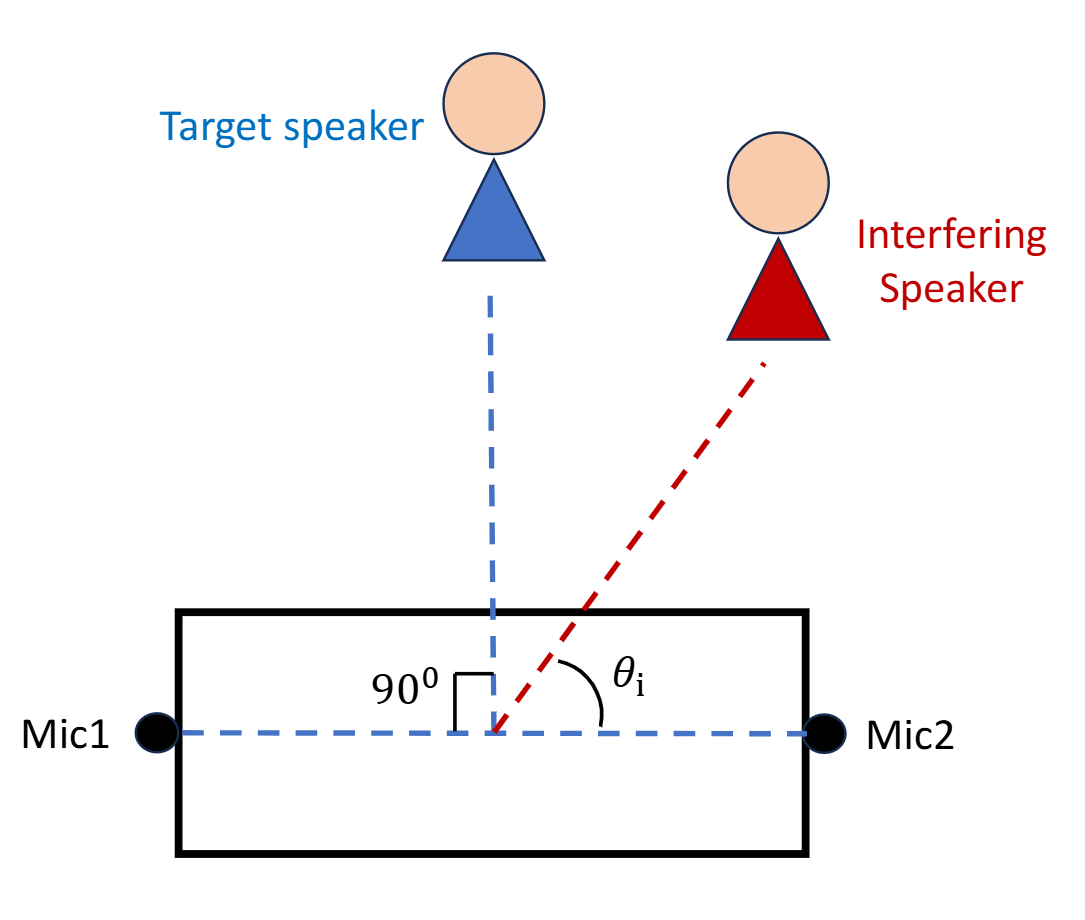
Audio-visual zooming on mobile devices is fundamentally constrained by limited microphone count, compute resource, unknown array geometry, and weak assumptions on real-world acoustic conditions. We present RDSE: Real-Time Directional Speech Enhancement Framework, a hybrid pipeline that combines traditional signal processing and modern machine learning methods for dual-microphone low-end smartphones. Unlike tightly coupled AV systems that continuously use visual feeds or embeddings, RDSE decouples visual interaction from feature inference, using camera input solely to parameterize the steering vector for spatial filtering. The proposed system uses four modules: dereverberation network, a beamformer with a temporal convolutional network, and a MetricGAN based denoiser. Extensive evaluation on benchmark data and real-world recordings demonstrates effective zooming without precise geometry calibration.

Methodology

RDSE Architecture Block Diagram

Figure 2: Block diagram of the proposed RDSE processing pipeline.

The RDSE pipeline integrates classical spatial filtering with modular, pretrained neural enhancement stages in a cascaded architecture operating on dual-microphone audio. The core components include:

  • Dereverberation (U-Net): Applied independently to each microphone channel to suppress late reflections and stabilize spatial covariance estimation.
  • MVDR Beamforming: Provides spatial selectivity based on a user-specified listening direction, without requiring precise geometric calibration.
  • Speaker Extraction (Conv-TasNet): A temporal convolutional network that refines the beamformer output by extracting the dominant target speaker.
  • Denoising (MetricGAN): A final stage that estimates a magnitude mask to suppress residual non-speech components and improve perceptual quality.

Citation

@misc{deo2026rdserealtimedirectionalspeech,
      title={RDSE: Real-Time Directional Speech Enhancement Framework for Dual-Mic Commodity Smartphones}, 
      author={Chinmay Deo and Danish Mahajan and Soudeep Ghoshal and Himanshu Buckchash},
      year={2026},
      eprint={2610.12476},
      archivePrefix={arXiv},
      primaryClass={cs.SD},
      url={https://arxiv.org/abs/2610.12476}, 
}